
Eastrise Group launches Advisory Board for Africa-Europe business
30 September 2025

The board unites global leaders to reframe risk, unlock cross-regional opportunities, and build equitable investment corridors. 

Eastrise Group, a strategy and insights firm connecting business and capital across Europe and Africa, today announced the launch of the Eastrise Advisory Board. The Board unites seasoned entrepreneurs and experts in artificial intelligence, sustainability, impact investment, development finance, communications, and policy reform to strengthen cross-regional business between Africa and Europe.

The launch comes at a pivotal moment for global business. Africa will be home to the world’s largest working-age population by 2040, with the potential to reach a $29 trillion economy by 2050 (UNECA, 2021). Meanwhile, Central and Eastern Europe (CEE) is emerging as one of the fastest-growing regions globally, with Poland recently surpassing $1 trillion in GDP. Yet despite these trajectories, global capital flows remain constrained by outdated perceptions of risk and limited cross-regional connectivity. 

Eastrise exists to close this gap. The Advisory Board will ensure that the firm’s clients, ranging from investors to corporates and philanthropic organisations, gain access to the insights, networks, and credibility needed to succeed across both regions. 

“Emerging markets are often dismissed as risky when, in fact, they are hubs of innovation and growth,” said Gosia Brzezińska, Founder and CEO of Eastrise Group. “Our Advisory Board strengthens the value we bring to clients, helping them navigate complex markets, design strategies rooted in local realities, and open doors to trusted partnerships that unlock growth.” 

Unlike conventional governance bodies, the Advisory Board is designed as a circle of advisors. Members will serve as strategic sounding boards, ensuring Eastrise delivers rigorous, equitable, and practical outcomes for clients. Their perspectives will elevate visibility for African-led opportunities, while ensuring that Eastrise’s work draws on the lessons of CEE’s transformation experience. 

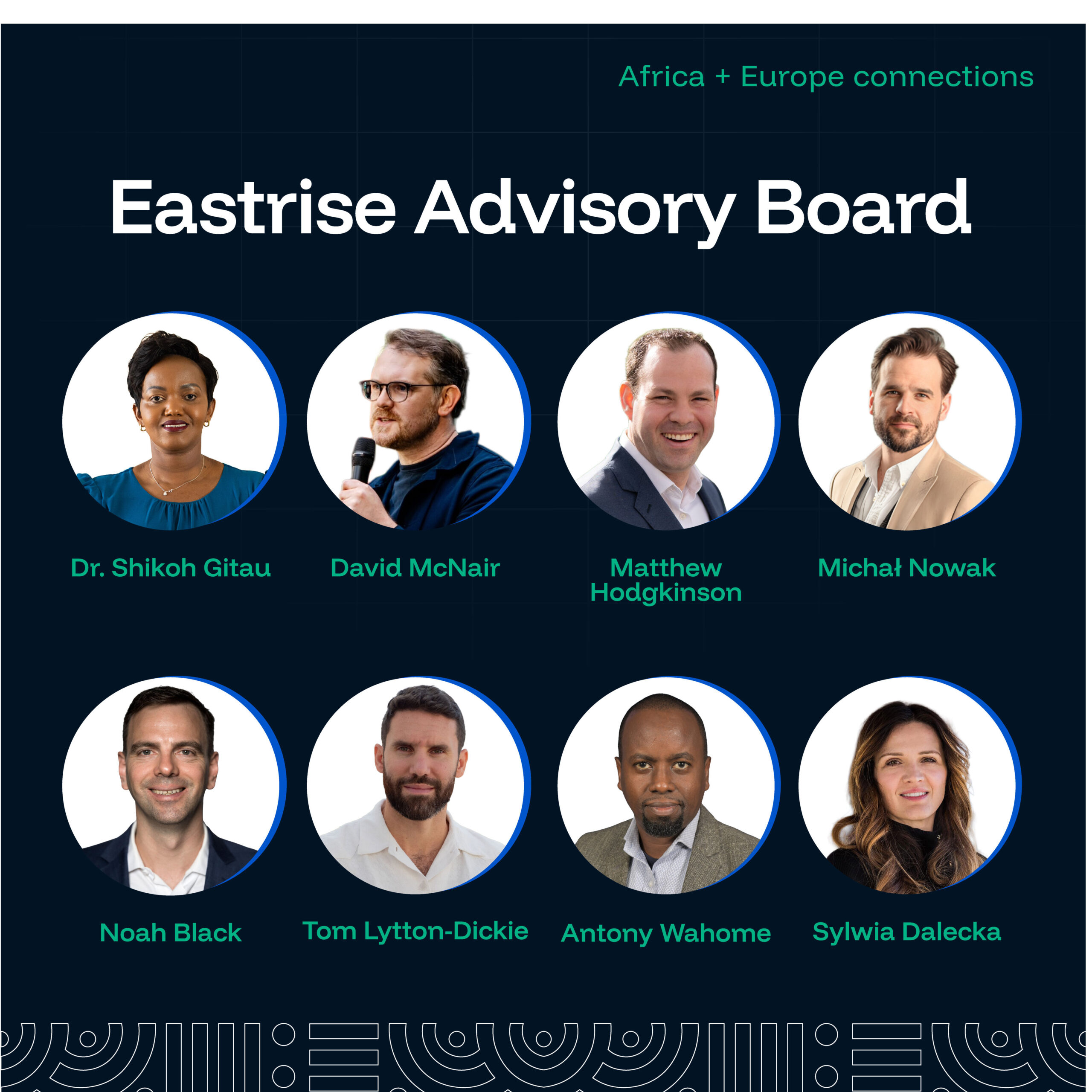
The Advisory Board comprises the following distinguished members: 

  • Noah Black, CEO, Co-Founder, Threshold 
  • Sylwia Dalecka, Founder, Polish Business Hub Davos 
  • Shikoh Gitau, CEO, Qhala 
  • Matthew Hodgkinson, Co-Founder and Portfolio Manager, Confluence Impact Fund 
  • Tom Lytton-Dickie, Founder & CEO, Meaningful Business 
  • David McNair, Executive Director, ONE 
  • Michał Nowak, CEO, Okaeri Consulting 
  • Antony Wahome, Economic Development Advisor 

David McNair, Executive Director at the ONE Campaign, added: “In a world beset by instability and insecurity, the only sustainable path to prosperity is through partnerships built on mutual interest. Africa offers fast-growing markets, critical minerals for the green transition, and world-class innovation in areas like mobile finance and renewable energy. Europe brings technology, capital, and global influence. Together, they can build the kind of prosperity and security that are so badly needed in today’s world.” 

Dr. Shikoh Gitau, CEO of Qhala, commented: “Africa is already building the future, from financial services to health AI,  to climate-smart agriculture. The real barrier is not capacity but visibility: ensuring African-led solutions are recognised and scaled globally. That’s where cross-regional bridges become powerful.” 

Michał Nowak, CEO of Oakeri Consulting, reflected on the shared lessons between regions: “Central and Eastern Europe’s story is one of resilience from navigating transition, building institutions, to finding new paths to growth. Those experiences can resonate with Africa’s own journeys, just as Africa’s innovation can offer fresh insight for Europe. It’s about exchange, building corridors where both regions learn and benefit.” 

As the Advisory Board commences its work, Eastrise invites partners from across business, philanthropy, and policy sectors to collaborate in creating inclusive investment corridors between Africa and Europe. By combining trusted insights, bold ideas, and cross-regional capital, Eastrise seeks to redefine risk and unlock opportunities for the next generation of global growth. 
Redrawing the map: Moses Sitati on Africa + Europe collaboration, narrative shifts, and cross-regional strategy

13 August 2025

Eastrise Group’s Kenya Country Director reflects on how Europe can become a more strategic partner to Africa, and why getting the narrative right is a global imperative.

Africa is often framed through the lens of risk, but that framing comes at a cost. The continent loses an estimated $4.2 billion annually due to inflated borrowing costs and receives just 2% of global clean energy investment, despite holding immense potential for renewable energy leadership. Perception, as much as policy, shapes outcomes.

For Moses Sitati, Kenya Country Director at Eastrise Group, the issue is not whether Africa matters to investors and new market opportunities, but how the rest of the world chooses to see and engage with it.

Why is it important to reimagine how Africa and Europe partner?

We’re at an inflection point globally. Geopolitical stability is shifting, multilateralism is under strain, and new growth models are emerging. Africa cannot afford to be positioned as a passive recipient in that landscape. It has to be, and deserves to be, a strategic partner in shaping global outcomes. Africa needs to, and has to, articulate what it wants from the rest of the world whether at a country or regional level, and to create vehicles through which it can realise those outcomes.

That shift requires rethinking how partnerships work. This is not about aid. It’s about investment, enterprise, innovation – and how these can be mobilised in ways that are aligned with Africa’s priorities. 

It’s also about agency: ensuring African voices shape the structures we co-create.

Why are you looking to build business with Central and Eastern Europe in mind?

CEE countries have gone through seismic transitions – politically, economically, institutionally. Many were once recipients of aid and are now navigating their own development cooperation agendas. That lived experience matters.

For example, Estonia and Poland successfully leveraged development aid to support their post-communist transitions and EU integration. Poland used support from the EU’s PHARE (Poland and Hungary Assistance for Restructuring their Economies) program, together with USAID assistance, and World Bank/IMF loans to stabilise its economy, reform institutions, and become the regional economic leader that it is today. Estonia, with significant aid from Nordic countries and EU pre-accession funds, rapidly modernised its governance, embraced digital innovation, and built strong institutions – emerging as a global leader in e-government and a high-performing EU member.

For Eastrise, CEE is not an add-on or a replacement for existing Western business ties, it’s the backbone of our different approach. Our strategy is grounded in the belief that peer learning from CEE’s transformation can enrich how business is done on the continent, how organisations can improve their operations, how we can reshape existing investment and funding models to ultimately change how Europe engages with Africa.

Our focus is ultimately on building stronger businesses – to create growth, jobs for growing populations, and strengthen new trade ties. We believe that CEE offers under-explored opportunities for meaningful collaboration, rooted in shared histories of transition and innovation with Africa.

CEE countries offer practical, transferable insights in areas like public sector reform, digital infrastructure, and SME development. As they increasingly seek to diversify trade and investment beyond the EU core, Africa is emerging as a natural partner. We want to help shape those relationships intentionally, not opportunistically.

You’ve spoken about “new corridors” between regions. What do you mean by that?

Too often, Africa + Europe relations are filtered through frameworks built in the 20th century. What we need now are new corridors, of trade, knowledge, capital, and cultural exchange, that reflect today’s realities and tomorrow’s needs.

We’re talking about African climate tech firms exporting to Eastern Europe. About CEE manufacturers co-investing in food processing in East Africa. About shared innovation ecosystems in digital public infrastructure. These aren’t pipe dreams – they’re possibilities waiting for the right frameworks.

But to unlock them, we need trust. And trust is built not just through conversations or political summits, but through consistent, practical engagement. Especially when it comes to building strong business partnerships.

Where do you see as the biggest barriers to progress?

Narrative and visibility. Africa is still perceived as monolithic and high-risk. Yet markets like Kenya are driving digital transformation at a scale that rivals anywhere in the world.

Just one example: in 2023, a coup in Niger triggered a 40-basis-point increase in Kenya’s bond yields. These are countries thousands of miles apart. That’s not objective risk, it’s market bias. Contrast that with Europe, where investor uncertainty in one country often leads to safer rates in another.

We also face a fragmentation challenge. Investors say they can’t see the pipeline, but the pipeline is there. The challenge is aggregation and translation: presenting viable African ventures in formats that resonate with global capital.

The opportunity areas are broad, we are looking at linking businesses and investments across dimensions such as the source of capital, founder citizenship, technology and equipment origin, market focus, and supply chain integration, among others. We feel that businesses that align with these nexus points provide strong potential for cross-regional trade, innovation exchange, and joint ventures. It is also a practical lens for identifying and scaling high-impact, corridor-based business opportunities.

What is Eastrise doing to support more balanced engagement?

We exist to build bridges. That includes advisory work, cross-regional investment readiness, policy insight, and amplifying success stories that don’t usually make headlines. As I mentioned, trust is built through practical engagement and we are doing that by creating direct linkages between and across businesses and investors to remove information asymmetries that cause blind spots. 

We’re especially focused on connecting the dots between under-recognised regions whether that’s a fintech founder in Nairobi or an Agritech pilot in Budapest. Our thesis is that value is often hidden in the margins, and that real transformation happens when those margins meet.

What would a more strategic Europe–Africa relationship look like?

It would be multidirectional. Not just investment flowing south, but ideas and models travelling both ways. It would be grounded in data and built on mutual accountability. It would avoid extractive patterns and favour co-creation.

We’d see more venture builders and accelerators working cross-regionally. More student and researcher exchanges. More inclusive conversations about green industrialisation and the digital economy. And, crucially, more trust in African-led solutions.

We want this to be a conversation which is finally changing, where more partners – governments, funders, corporates – are recognising that Africa isn’t waiting to be helped. It’s already building the future. And it has a lot to offer the world, including Europe. 

We just need to listen and connect accordingly.

The opportunities are here, the frameworks are emerging, and the trust is building. If you see your business playing a role in shaping a more strategic, multidirectional Africa + Europe relationship, we’d like to hear from you. Contact Eastrise Group to explore how we can work together and follow us on LinkedIn for more insights, opportunities, and stories from across these regions.

Eastrise Group appoints Moses Sitati as Kenya Director to help clients navigate and grow across African markets

16 July 2025, Nairobi, Kenya 

Eastrise Group has appointed Moses Sitati as its Country Director for Kenya, strengthening the firm’s commitment to reshaping how businesses in Africa and Europe partner for long-term inclusive growth. The appointment comes at a pivotal moment as Eastrise expands its advisory presence in East Africa and deepens its support for businesses, institutions, and investors navigating cross-regional collaboration.

The global trade order is being reshaped politically, economically, and structurally,” said Gosia Brzezińska, CEO, Eastrise Group. “Legacy ties and familiar routes no longer guarantee progress. To navigate what’s next, businesses need new alliances, fresh thinking, and bold models that reflect today’s complexity and tomorrow’s potential. Moses’s appointment strengthens our ability to deliver exactly that. Eastrise is here to help businesses grow through change and lead in the markets of the future.

With nearly two decades of experience across private sector growth, innovation, and development, Sitati brings a proven track record of building high-impact partnerships at organisations such as USAIDMicrosoftNokia, and the United Nations. His expertise spans blended finance, market development, digital transformation, and public–private collaboration.

Most recently, Sitati served as Partnerships Team Leader for Economic Growth at USAID Kenya and East Africa, where he led efforts to unlock private capital and scale enterprise-driven development across key sectors including agriculture, WASH, environment, health, clean energy, and digital infrastructure. In his new role, he will lead Eastrise’s strategy and operations in Kenya and East Africa, helping clients shape market strategies, expand across borders, and design programmes that unlock new forms of partnership and capital.

Throughout my career, I have worked at the intersection of enterprise, capital, and impact. I have built partnerships that unlock growth across sectors and borders,” said Sitati. “Joining Eastrise is a strategic decision. We are building a new corridor for business between Africa and Europe, starting with Central and Eastern Europe, but with a much broader vision. This is not about one-way investment flows. It is about helping clients on both sides grow, expand, and collaborate through models that are locally grounded and globally connected. That shift is long overdue, and we are here to lead it.

Sitati’s appointment signals a deep commitment to Eastrise’s founding mission: to support businesses in navigating complexity, unlocking capital, and scaling with purpose across regions. As Eastrise begins this next chapter, its focus is on building a new kind of consulting model, anchored in research, advisory, and a future-facing investment platform that helps organisations grow through change and shape what comes next.